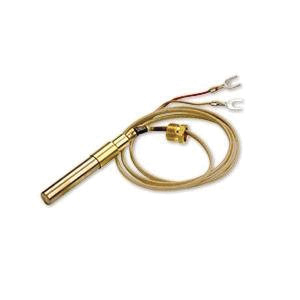

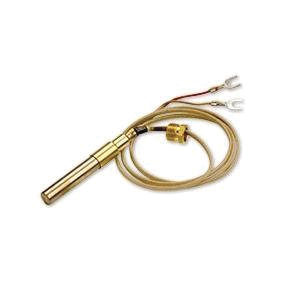

Robertshaw® Unitrol® 110 Series 21424 Thermopile, Stainless Steel, 3/8-32, Male Nut, 500 to 750 mV, 914 mm L Lead
- Manufacturer: Robertshaw
- Brand Name: Robertshaw®
- Part#: INV35-630501-001
- MPN: 21424
- UPC: 662013229399
- Min. Order Qty: 1
- Qty. Interval: 1
-
Availability:

- Branch Availability
-
Price:
-
Other Branch Availability
The Robertshaw® 1950 and 1951 Series Thermopiles lead the industry for gas appliance applications. Their primary function is to ensure a standing pilot light is operative so that on a call for heat, the main burner gas will be properly ignited. Thermopiles are placed in gas applications to detect the existence of a flame for safety purposes by shutting off the potential gas flow to a burner. A thermopile is the assembly of many thermocouples to increase the millivolt output. Robertshaw thermopiles have two types of connections: coaxial and two-wire spade connectors. The 1950 Series Thermopiles, also known as TP-75, are two-wire spade connectors. The 1951 Series Thermopiles, also known as CP-2 (250 to 750 millivolts), are coaxial connectors. The 1950 and 1951 Series Thermopiles (pilot generators) are designed for use on self-powered gas control systems. They can be used to replace similar competitive devices.
Robertshaw® Thermopile, Unitrol® 110 Series, Stainless Steel, 3/8-32 Connection, Connection Type: Male Nut, 500 to 750 mV, 914 mm Lead Length, Domestic/Import: Import
| Connection Size | : | 3/8-32 |
| Connection Type | : | Male Nut |
| Domestic/Import | : | Import |
| Lead Length | : | 914 mm |
| Material | : | Stainless Steel |
| Series | : | Unitrol® 110 Series |
| Voltage Rating | : | 500 to 750 mV |
- Easy burner installation with attached threaded nut
- Stainless steel outer jacket for long life and resistance to heat blistering
- Combination of copper and nickel alloys for good electrical conductivity
- Mica washer to insulate from shorting conditions
- Tinnerman clip included
- Various lengths available for multiple applications
 Specification Sheet